
Column Pipe Supplier in UAE: Choosing Pipe for Borewells and Submersible Pumps
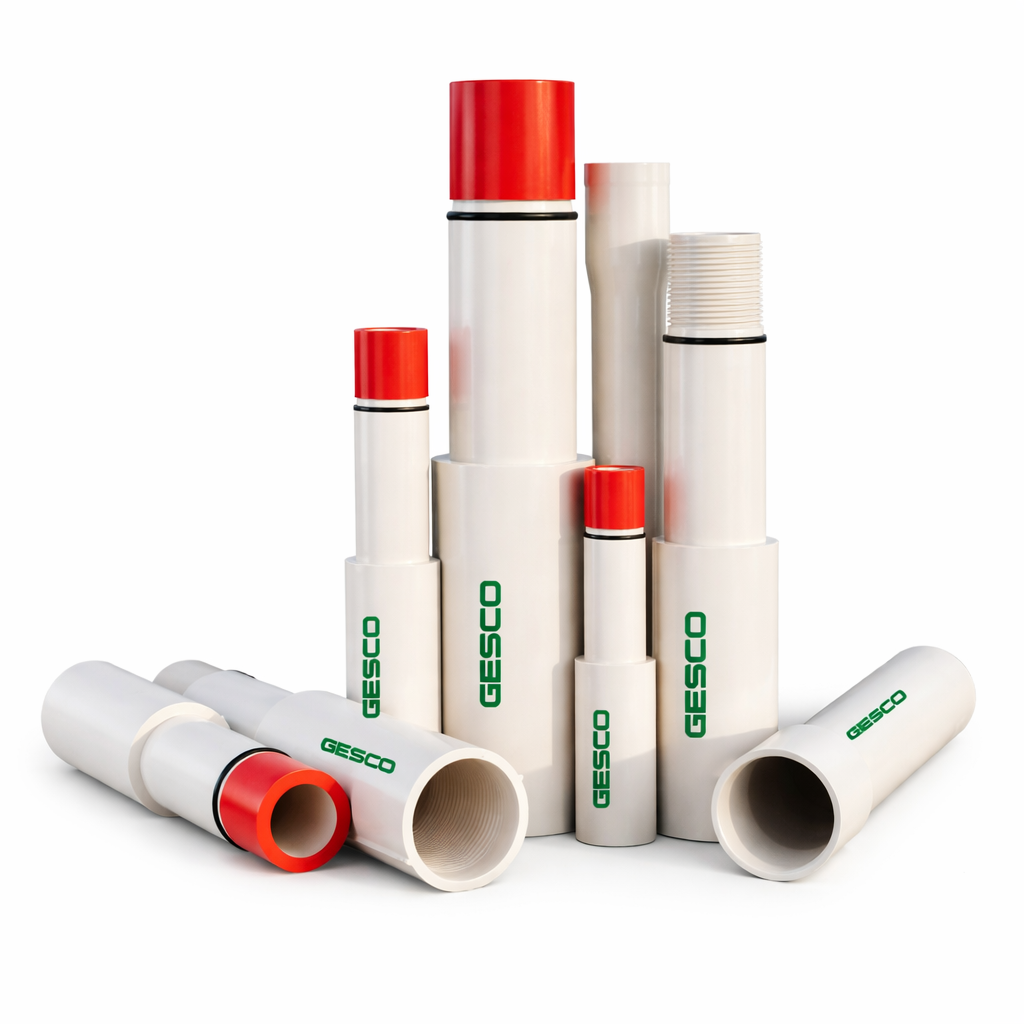
A column pipe carries the submersible pump, the water above it and its own weight, hanging vertically in a borehole for years. Get the class wrong and it fails at the thread, dropping the pump to the bottom of the well. Recovery costs more than the pipe, the pump and the installation put together, and in a deep well it sometimes is not recoverable at all.
That is the whole case for taking column pipe selection seriously, and for buying it from someone who can tell you the safe pulling load rather than just the price per metre.
What a column pipe does
Also called riser pipe, drop pipe or submersible pipe, the column pipe runs from the submersible pump at the bottom of the borewell up to the wellhead. It does three jobs at once:
- Carries water from the pump to the surface under pressure
- Physically supports the pump’s weight
- Takes the load of the water column standing inside it
Screen pipes are a different component. A slotted pipe installed in the water-bearing zone of the well, the screen allows groundwater into the bore while holding back sand and fine material. Most well installations need both.
Why uPVC replaced galvanised iron
GI column pipe was the standard for decades. It is now the wrong choice in most UAE installations, and the reason is water chemistry.
Groundwater across much of the Emirates is brackish, with high total dissolved solids and significant chloride content. That is aggressive to galvanised steel. GI column pipe in brackish water corrodes at the threads first, which is exactly where the load concentrates. Installations that should last fifteen years fail in four or five.
The comparison in practice:
| uPVC column pipe | GI column pipe | |
|---|---|---|
| Corrosion in brackish water | Unaffected | Attacks threads first |
| Weight | Roughly one fifth of GI | Heavy, needs more lifting gear |
| Scaling | No internal scale build-up | Scales, reducing bore and flow |
| Internal friction | Smooth bore, lower head loss | Roughens with age |
| Water quality | No iron leaching | Iron contamination as it corrodes |
| Installation | Two people can handle most sizes | Requires more equipment and labour |
| Re-use after pump service | Threads remain sound | Threads degrade each removal |
The weight difference compounds. Lighter pipe means less total load hanging in the bore, which means a lower class of pipe can carry the same pump to the same depth.
Where GI still has a place: very high pressure applications, some industrial installations, and wells where the water is hot enough to be outside uPVC’s temperature range.
Sizes and pressure classes
uPVC column pipes are normally supplied in 3 metre lengths, threaded at both ends, in sizes from 1 inch to 6 inch.
| Nominal size | Outside diameter |
|---|---|
| 1″ | 33 mm |
| 1¼” | 42 mm |
| 1½” | 48 mm |
| 2″ | 60 mm |
| 2½” | 75 mm |
| 3″ | 88 mm |
| 4″ | 113 mm |
| 5″ | 140 mm |
| 6″ | 165 mm |
Each size is manufactured in several pressure classes. Naming varies by manufacturer, but the structure is consistent:
| Class | Safe hydrostatic pressure | Typical installation depth |
|---|---|---|
| Medium | 12.5–15 kgf/cm² | up to 150 m |
| Crystal / Standard | 20–26 kgf/cm² | up to 250–300 m |
| Heavy | 30–35 kgf/cm² | up to 350 m |
| Super Heavy | 40 kgf/cm² and above | 400 m |
Manufacturers to IS 12818 publish, for each size and class, the ultimate breaking load, the safe pulling load with a chain pulley, the safe allowable hydrostatic pressure and the safe installation depth. Ask for that table. A supplier who cannot produce it is selling pipe without knowing what it will hold.
How to select the right class
Two separate checks, and the pipe has to pass both.
Check one: pressure
There is a simple rule for the standing water column. Every 10 metres of water above the pump adds roughly 1 kg/cm² of pressure.
The pump’s delivery pressure must not exceed the pipe’s safe allowable hydrostatic pressure.
Worked example. A pump delivering 25 kg/cm² on a 2 inch column. A Standard class 2 inch pipe rated at 20 kg/cm² is not adequate — the pump can generate more pressure than the pipe is rated to hold. Move up to Heavy class.
Check two: load
Total suspended load is the sum of three weights:
- The pipe itself over the full installed length
- The water standing inside the pipe
- The pump and motor
That total must sit safely below the pipe’s safe pulling load, not its ultimate breaking load. The gap between those two figures is your safety factor and it exists for a reason: the pipe takes shock loading during installation and extraction, and a pump that has silted in needs real force to free.
A rough field sense of scale: a 2 inch column at 150 metres carries a few hundred kilos of pipe and water before the pump is added. Use the manufacturer’s table for the actual figures rather than estimating.
The third thing people forget
The borehole must be at least 2 inches larger in diameter than the outside diameter of the pump. Tight clearance makes installation difficult and extraction worse.
Threads, joints and adaptors
Column pipe joints are where installations fail, so the details matter.
Threading. Quality column pipe uses precision CNC-cut square or trapezoidal threads, commonly 11 TPI, cut to hold axial load rather than just seal. The thread form on a column pipe is doing structural work.
O-ring seals. EPDM O-rings at each joint make the seal. Fit new O-rings every time a pump is pulled and reinstalled. Re-using compressed O-rings causes leaks partway down the column, which show up as poor delivery at the surface and get misdiagnosed as pump failure.
Pin locks. Stainless steel locking pins on many systems prevent the joint unscrewing under the torque reaction when the pump starts. Starting torque on a large submersible is significant and it acts to loosen the column.
Adaptors. Stainless steel or cast iron adaptors connect the uPVC column to the pump at the bottom and to the wellhead at the top. Stainless is the sensible choice in brackish water for the same reason the pipe is uPVC.
Screen pipes
For the water-bearing section of the well, slotted uPVC screen pipe lets groundwater enter while keeping sand out. Slot size is selected against the grain size of the surrounding formation — too wide and the well pumps sand, which destroys pump impellers quickly; too narrow and yield suffers.
In sandy formations, and much of the UAE qualifies, the screen and the gravel pack around it determine whether the well produces clean water or grinds a pump to scrap inside a year.
UAE regulations worth knowing before you drill
Groundwater is regulated in the UAE and the rules have tightened.
In Abu Dhabi, groundwater is governed under Law No. 5 of 2016, administered by the Environment Agency – Abu Dhabi. Drilling a new well, deepening an existing one, increasing its diameter or installing a pump requires a licence. Well owners must install water meters, register wells, stay within permitted extraction limits and maintain the installation. Penalties for unlicensed drilling are substantial. EAD has also designated areas where new wells are prohibited outright.
In Dubai, borehole drilling falls under Dubai Municipality requirements, and drilling contractors must be licensed.
The practical point for anyone buying column pipe: confirm the licensing position before ordering materials. Contractors working on farms, landscape projects and construction dewatering in the UAE deal with this routinely, but private plot owners are frequently caught out.
Applications across the UAE
Agriculture. Farms in Al Ain, Liwa and the northern emirates run irrigation from groundwater wells, and the sector accounts for the large majority of groundwater extraction in Abu Dhabi.
Landscape and amenity. Hotel grounds, golf courses, parks and large villa developments irrigating from licensed wells.
Construction dewatering. Lowering the water table on excavation sites, particularly in coastal Dubai where groundwater sits close to the surface.
Industrial supply. Process and washdown water at industrial sites.
Labour accommodation and remote facilities. Sites outside the municipal supply network.
Buying column pipe from GescoStore
GescoStore supplies UPVC pipes for well and pumping applications across the UAE and GCC, including UPVC column pipes for submersible pump installations and UPVC screen pipes for the water-bearing section of the bore.
Alongside the pipe, GescoStore stocks the fittings a well installation needs, including valves such as check valves and gate valves, GI fittings and MS fittings.
For pipe selection, send the pump specification, the delivery head and the installation depth and the technical team will confirm the appropriate size and class. Submit a quote request through the product pages, use the bulk enquiries form for project quantities, or call +971 4 236 5500.
Frequently Asked Questions
What is a column pipe used for? A column pipe, also called a riser or drop pipe, connects a submersible pump at the bottom of a borewell to the surface. It carries the water up and supports the weight of the pump and the water column.
Which is better for borewells in the UAE, uPVC or GI column pipe? uPVC in almost all cases. UAE groundwater is typically brackish with high chloride content, which corrodes galvanised steel at the threads. uPVC does not corrode or scale, weighs about a fifth of GI, and does not leach iron into the water.
What sizes do uPVC column pipes come in? Standard sizes run from 1 inch (33 mm OD) to 6 inch (165 mm OD), normally in 3 metre threaded lengths, each available in several pressure classes.
How do I choose the pressure class? Two checks. First, the pump’s delivery pressure must not exceed the pipe’s safe hydrostatic pressure rating — allow roughly 1 kg/cm² for every 10 metres of water column. Second, the combined weight of pipe, water and pump must sit below the pipe’s safe pulling load. Use the manufacturer’s load table for the specific size and class.
How deep can a uPVC column pipe be installed? Depends on class. Medium class suits up to around 150 metres, Standard up to 250–300 metres, and Heavy or Super Heavy classes reach 350 to 400 metres. Larger diameters and higher classes carry more.
What is the difference between a column pipe and a screen pipe? A column pipe is solid and carries water from the pump to the surface. A screen pipe is slotted and sits in the water-bearing zone, allowing groundwater into the bore while holding back sand.
Do I need a permit to drill a water well in the UAE? Yes. In Abu Dhabi, drilling, deepening or installing a pump requires a licence from the Environment Agency – Abu Dhabi under the 2016 groundwater law, with metering and extraction limits applied. Dubai has its own municipality requirements. Confirm the position before ordering materials.
Do you supply column pipe fittings and adaptors? Yes. GescoStore supplies pipe alongside valves, GI and MS fittings for well and pumping installations. Send your pump and well details for a matched quotation.